て Form (Basic ㊦ 464)
The て form ending of verbs and い-type adjectives (The て form ending of な-type adjectives and the て form of the copula is で.)
Equivalent: And; -ing
| (i) Group 1 verbs | ||
| すverbs | 話す→話して | Someone talks and |
| くverbs | 歩く→歩いて | Someone walks and |
| Exception | 行く→行って | Someone goes and |
| ぐverbs | 泳ぐ→泳いで | Someone swims and |
| む/ぶ/ぬverbs | 飲む→飲んで | Someone drinks something and |
| 遊ぶ→遊んで | Someone plays and | |
| 死ぬ→死んで | Someone dies and | |
| つ/う/るverbs | 待つ→待って | Someone waits and |
| 買う→買って | Someone buys something and | |
| 取る→取って | Someone takes something and | |
| (ii) Group 2 verbs | Vstemて | |
| 食べて | Someone eats something and | |
| (iii) Irregular verbs | 来る→来て | Someone comes and |
| する→して | Someone does something and | |
| (iv) Adjective い | Adjective い stem くて | |
| 高くて | Something is expensive and | |
| (v) Adjective な | Adjective な stem で | |
| 静かで | Something is quiet and | |
| (vi) Noun+copula | Nで | |
| 先生で | Someone is a teacher and |
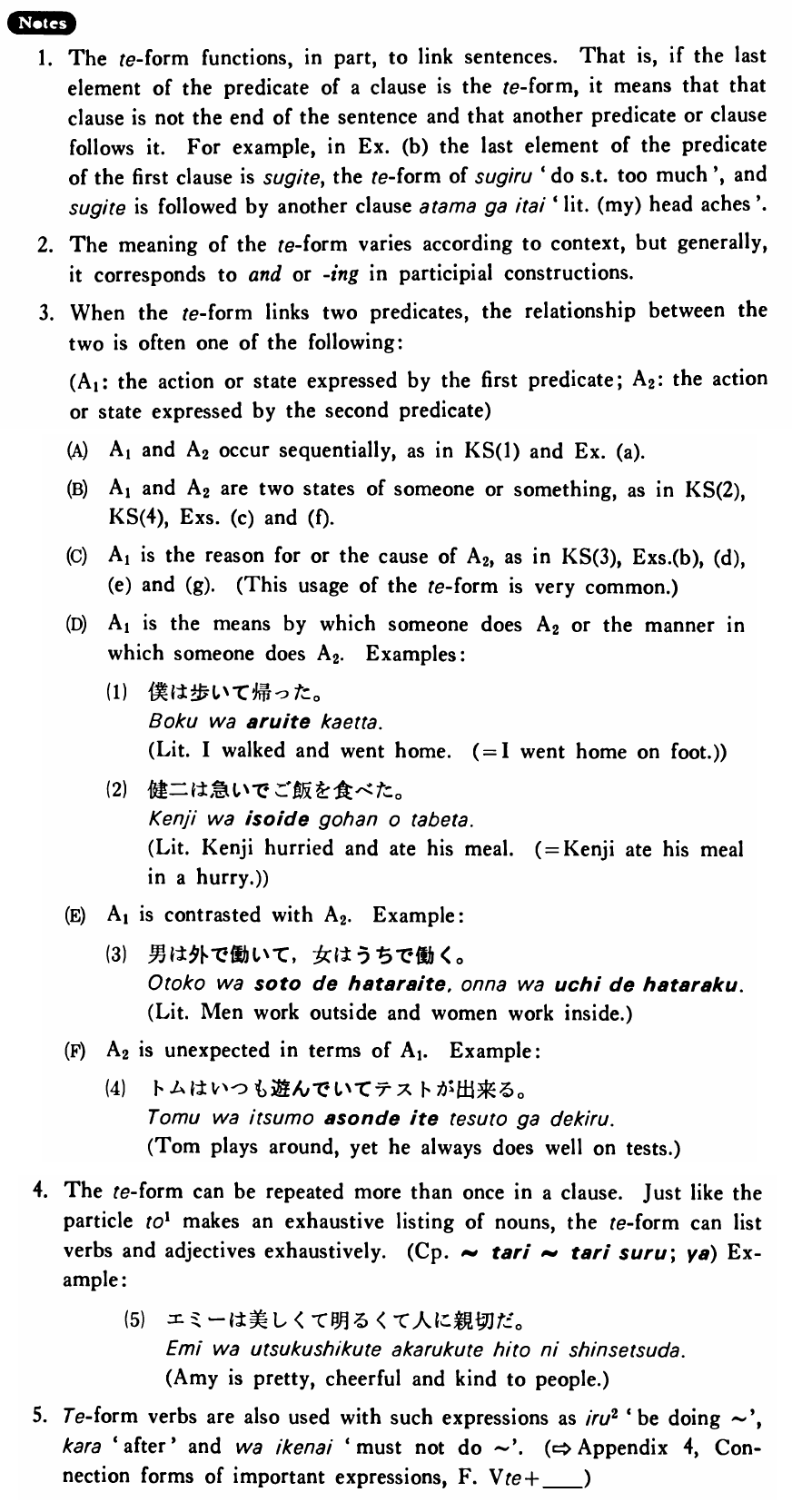
1. The て form functions, in part, to link sentences. That is, if the last element of the predicate of a clause is the て form, it means that that clause is not the end of the sentence and that another predicate or clause follows it. For example, in Example (b) the last element of the predicate of the first clause is 過ぎて, the て form of 過ぎる 'do something too much',and 過ぎて is followed by another clause 頭が痛い 'literally:(my) head aches'.
2. The meaning of the て form varies according to context, but generally, it corresponds to 'and' or '-ing' in participial constructions.
3. When the て form links two predicates, the relationship between the two is often one of the following:
[A1: the action or state expressed by the first predicate; A2: the action or state expressed by the second predicate]
4. The て form can be repeated more than once in a clause. Just like the particle と1 makes an exhaustive listing of nouns, the て form can list verbs and adjectives exhaustively. (Related: たり~たりする; や) Example:
5. て form verbs are also used with such expressions as いる1 'be doing ~', から 'after' and はいけない 'must not do ~'.